
Crime
Annunciation Catholic Church School Shooter Robin Westman Manifesto Reveals Regret Over Gender Transition


Authorities have confirmed that the Minneapolis school shooter, identified as 23-year-old Robin (Robert) Westman, left behind a manifesto posted online shortly before carrying out the deadly attack at a Catholic school and church in Minnesota.
In the writings, which were shared on YouTube and composed partly in English and partly in Russian using Cyrillic script, Westman expressed deep regret over undergoing a gender transition and described ongoing struggles with identity.
Westman wrote extensively about dissatisfaction with personal appearance, particularly regarding long hair associated with the transition.
“I only keep [the long hair] because it is pretty much my last shred of being trans. I am tired of being trans, I wish I never brain-washed myself,” Westman wrote.
The manifesto further revealed Westman’s internal conflict and frustration over perceived failures in achieving a desired physical identity.
“I can’t cut my hair now as it would be an embarrassing defeat, and it might be a concerning change of character that could get me reported. It just always gets in my way. I will probably chop it on the day of the attack.”
The writings also disclosed regret and despair regarding transitioning.
“I regret being trans. I wish I was a girl, I just know I cannot achieve that body with the technology we have today. I also can’t afford that.”
The attack left two children dead and dozens of others injured before Westman took his own life, according to investigators.
Authorities are continuing to review the online postings as part of their broader investigation into the motive behind the shooting.









Crime
Who Is the Hero Teacher, Threw a Phone at Gunman John J. Griffin II, Tackled Him, and Fought Back During the Silver Rail Elementary School Shooting?
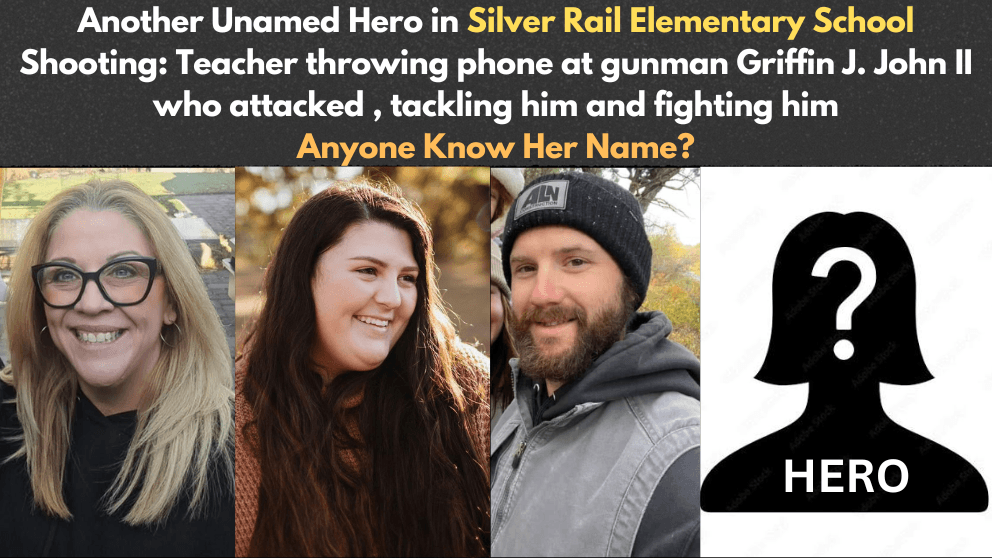
Another Unamed Hero in Silver Rail Elementary School Shooting: Teacher throwing phone at gunman Griffin J. John II who attacked , tackling him and fighting him.
Anyone Know Her Name? She Must Be Praised Just Like Kaylub Giamanco
BEND, Oregon — Becky Drury, a 54-year-old teacher at Silver Rail Elementary School in Bend, Oregon, sustained serious injuries during the deadly school shooting on Thursday, October 15, 2026. Drury suffered gunshot wounds to her left arm and right hand and underwent surgery, according to the information shared about the incident.
As Drury begins what could be a lengthy recovery, new details have also emerged about the reported actions of another teacher who allegedly confronted the gunman during the attack. According to the account attributed to Bend Police Chief Mike Krantz during a press conference, the unidentified teacher threw a phone at the suspect, tackled him, and fought back.
The teacher reportedly escaped the confrontation without physical injuries. Officials were said to have clarified that earlier information suggesting the teacher had been injured was incorrect.
Drury was among those injured in the shooting at Silver Rail Elementary School. She sustained injuries to her left arm and right hand and required surgery.
Although the injuries were described as serious, the information provided indicates that she survived the operation. Her recovery may involve additional medical treatment, rehabilitation, and emotional support as she works to recover from the traumatic experience.
Her family, colleagues, students, and community members are hoping for her continued improvement and a successful recovery.
The shooting has left the school community dealing with grief, fear, and uncertainty. For those injured, the challenges extend beyond immediate medical care, as they and their loved ones face the psychological and emotional consequences of the violence.
Additional details attributed to Bend Police Chief Mike Krantz describe the actions of another Silver Rail Elementary School teacher who reportedly confronted the gunman during the attack.
According to the account provided, the unidentified teacher threw a phone at the suspect, tackled him, and physically fought back. The teacher was reportedly not injured, contrary to earlier information about the confrontation.
The teacher’s reported actions have drawn attention because confronting an armed attacker can involve extraordinary personal risk. However, the precise sequence of events and the extent to which the confrontation affected the outcome should be established through official statements and investigative findings.
The teacher’s identity has not been provided in the supplied information. Protecting that person’s privacy may be particularly important while the school community and those directly involved continue to process the incident.
The supplied account also identifies Kaylub Giamanco as the person who reportedly shot and killed the suspect during the incident.
The suspect has been identified in earlier reports as John J. Griffin II, a 16-year-old. However, the exact spelling and order of the suspect’s name should be confirmed against official law enforcement records before publication.
The reported intervention by Giamanco and the actions attributed to the unidentified teacher are separate aspects of the developing account. Their precise roles and the circumstances surrounding the suspect’s death should be described using verified statements from investigators.
As Becky Drury faces recovery, messages of support and prayers are being shared for her and everyone affected by the shooting.
Teachers and school staff often play a central role in supporting children, particularly during frightening and uncertain situations. The reported actions of Drury’s colleague have prompted expressions of appreciation, although the full circumstances should be confirmed before drawing definitive conclusions about what happened.
The emotional impact of a school shooting can continue long after the immediate danger has passed. Survivors, families, students, educators, and first responders may need access to counseling, mental health resources, and other forms of assistance.
Community support may also help families and injured staff members manage medical costs, time away from work, and other practical challenges during recovery.
The Silver Rail Elementary School shooting has left the Bend community confronting profound loss and uncertainty. As families mourn those who died, attention is also turning to the survivors who must navigate the difficult process of healing.
Becky Drury’s recovery remains an important concern for her loved ones and colleagues. The unidentified teacher who reportedly confronted the gunman may also need emotional support after experiencing such a traumatic event, even without physical injuries.
Prayers and support are being extended to Becky Drury, her family, the teacher who reportedly intervened, and every student, family, and staff member affected by the tragedy.